When Your Student Says, "I Don't Know What to Write"
When a Student Says, "I Don't Know What to Write": What Happens Next
The cursor blinks.
The assignment is open.
The student stares at the screen for a long moment before finally saying, "I don't know."
If you've ever sat beside a student who insists they have nothing to write, this scene probably feels familiar.
Here's the thing, though.
Most of the time, I don't think the problem is a lack of ideas.
I think the problem is figuring out how to get those ideas out of a student's head and onto the page.
If you've ever been tempted to jump in with ideas or say, "Just write anything," you're definitely not alone.
Parents are sometimes surprised by what I don't do next.
I don't hand them a graphic organizer.
I don't start correcting grammar.
And I definitely don't say, "Just write something."
Instead, I start asking questions.
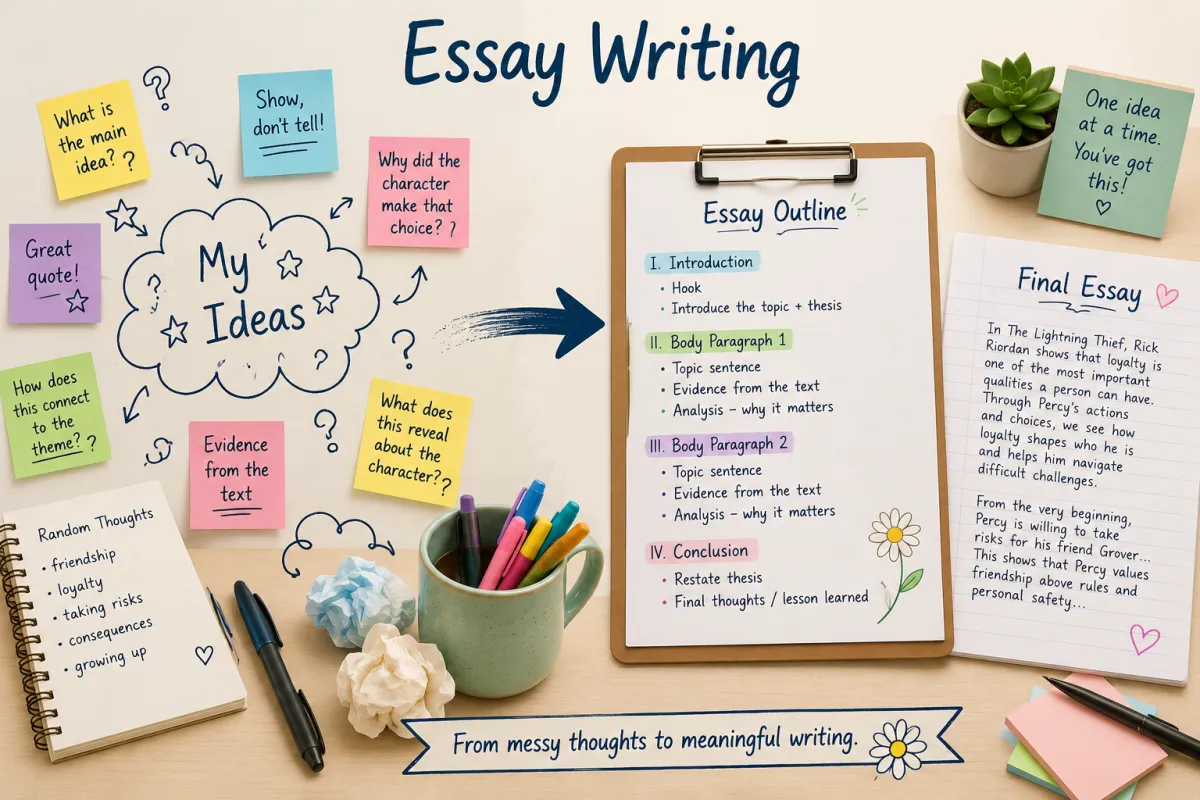
One question becomes two. Two become five. Before long, the blank page isn't so blank anymore. Together, we're uncovering ideas the student had all along. My job isn't to put ideas into a student's head. It's to help them discover that they already have something worth saying.
It Usually Starts With One Tiny Idea
Most of the time, when a student tells me, "I don't know," I don't believe them.
Not because they're trying to get out of the assignment—although, let's be honest, that does happen sometimes.
Occasionally I get the classic teenage response: "I dunno." That's okay. We can work with "I dunno."
I don't believe them because, after a few minutes of talking, they almost always have an opinion.
It might be only one sentence.
"I think the character was selfish."
Perfect.
Now we have somewhere to start.
Here's what that conversation might sound like.
Student: "I think the character was selfish."
Me: "Okay...what makes you think that?"
Student: "Because he left his friend."
Me: "Did he? Can you show me where that happened?"
(A minute or two of flipping through the text...)
Student: "Well...he didn't exactly leave him. He thought he was protecting him."
Me: "That's interesting. So is selfish still the best word, or would you choose a different one?"
That's the moment I love.
The student isn't just writing anymore—they're thinking. They're going back to the text, looking for evidence, and refining their ideas.
From there, I keep asking questions.
"Can you show me where you saw that?"
"What happened right before that?"
"Okay...prove it."
"Could someone see that differently?"
Little by little, the conversation grows. The student starts making connections they hadn't seen a few minutes earlier. They begin finding evidence to support those ideas. Before long, we've gone from "I don't know" to several strong points that deserve to be in the paragraph.
Only then do we worry about organizing those ideas into good writing.
Where Technology Comes In
You may have noticed that I haven't talked much about technology yet.
That's because it isn't the star of the lesson.
It's simply one of the tools that helps us keep the conversation moving.
My students and I are usually working together in the same Google Doc. Sometimes I'm typing. Sometimes they're typing. Sometimes we're both adding notes at the same time.
Yes, it can get a little chaotic.
But that's okay. We're getting ideas onto the page before they disappear.
Instead of trying to remember every thought while also worrying about spelling, punctuation, or the perfect first sentence, the student can simply focus on thinking. Their ideas are already on the page, ready to organize.
Once those ideas are safely there, the pressure starts to disappear.
Instead of staring at a blinking cursor, we're looking at a page full of possibilities. Now we can decide which ideas belong together, which piece of evidence is strongest, and how to build a clear, organized paragraph.
That's when the real writing begins.
Writing Starts Before the First Sentence
One of the biggest misunderstandings about writing is that it starts with the first sentence.
It doesn't.
Writing starts with thinking.
It starts with noticing something in the text.
It starts with asking questions.
It starts with making connections and finding evidence.
The typing comes later.
That's why I tell students not to worry about grammar or spelling right away. We'll get there. First, let's figure out what they actually want to say.
Once we have the ideas, we can organize them. Then we can strengthen them. Finally, we can polish the writing.
Trying to do all of those things at once is enough to overwhelm almost anyone. Breaking the process into smaller steps helps students focus on one thing at a time.
Instead of asking, "Can you write a paragraph?"
I ask, "What are you thinking?"
More often than not, that's the question that gets the words flowing.
Try This at Home
The next time your student says, "I don't know," don't jump in with an answer.
Instead, try asking:
"What's your first impression?"
"What makes you think that?"
"Can you show me where you found that?"
"Okay...prove it."
You may discover they knew more than they realized—they just needed someone to ask the next question.
A Blank Page Doesn't Mean a Blank Mind
The next time your student stares at a blinking cursor and says, "I don't know," remember that those words don't always mean they have nothing to say.
Sometimes they simply need someone to help them untangle their thoughts.
Whether you're sitting beside your student at the kitchen table or I'm sitting with them in a shared Google Doc, the goal is the same: helping them discover they already have something worth saying.
That's my favorite part of teaching.


