How Dungeons & Dragons Can Improve Writing Skills
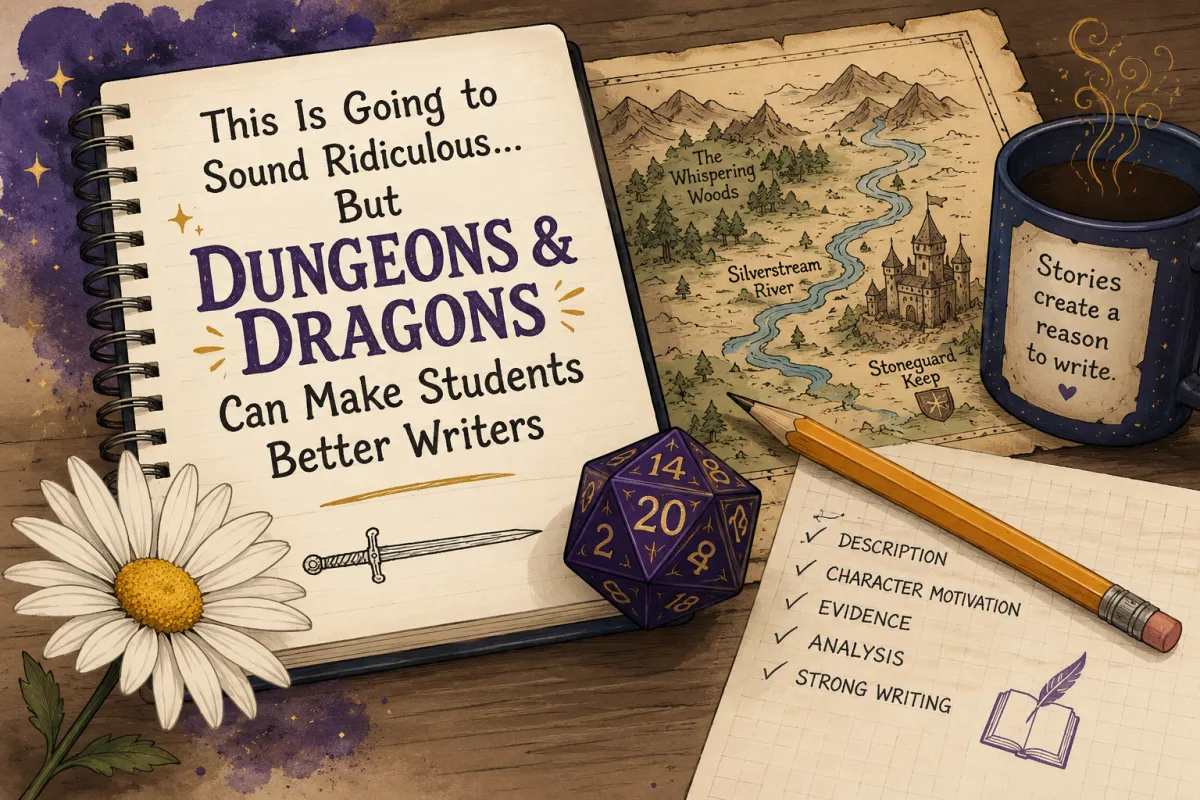
This Is Going to Sound Ridiculous... But Dungeons & Dragons Can Make Students Better Writers
One of the questions I hear most often from parents is, "How do I get my student to actually enjoy writing?"
It's a fair question. If writing has become a nightly battle filled with sighs, blank pages, and comments like, "I don't know what to write," it's hard to imagine that the answer might involve a twenty-sided die.
Stay with me.
A while back, I worked with a student whose writing rarely ventured beyond short, simple sentences. If I asked him to describe a setting, I'd get something like, "The forest was dark." If I asked about a character, the answer was usually, "He was brave."
There wasn't anything technically wrong with his writing.
It just didn't have much life in it.
Then one day, we created a character for a Dungeons & Dragons adventure.
Meet Thorne.
At first, Thorne wasn't much more interesting than the writing itself. He was a ranger with a bow, a backpack, and... well... that was about it.
Then I asked one question.
"Why does Thorne travel alone?"
The student paused.
He thought.
Then he smiled.
That single question opened a door. Before long, Thorne had a past, a reason for carrying an old copper coin everywhere he went, and a habit of taking the first watch every night because of something that had happened years earlier.
Without realizing it, my student wasn't just inventing a fantasy character anymore.
He was learning to write.
If you've never played Dungeons & Dragons, you might be wondering how pretending to fight dragons could possibly help with essays and literary analysis.
As odd as it sounds, storytelling is one of the most natural ways to develop strong writers.
And that's where Thorne's journey—and my student's—really began.
"Isn't Dungeons & Dragons Just a Game?"
At this point, you may be thinking exactly what I'd be thinking if someone suggested teaching writing with a role-playing game.
"This sounds like fun, Ms. Virginia... but when does the learning happen?"
The short answer?
The learning is happening the whole time.
One of the biggest challenges reluctant writers face isn't grammar or vocabulary.
It's finding something they genuinely want to say.
Ask a student to write three descriptive paragraphs about a mysterious forest, and you may get three sentences before they run out of ideas.
Ask that same student to describe the forest because Thorne has to sneak through it without alerting a pack of hungry wolves...
Now the details matter.
Is the ground muddy enough to leave footprints?
Can Thorne hear the river nearby?
Would moonlight help him see—or help someone else see him?
Without anyone saying, "Add more sensory details," students begin adding them because those details suddenly have a purpose.
That's why I enjoy using Dungeons & Dragons with some students.
The game isn't replacing writing.
The game becomes the reason to write.
Watching a Writer Grow
One of the things I tell students all the time is that good writing isn't about using the biggest words you know.
It's about helping your reader see what you see.
When we first started building Thorne's story, the writing looked something like this:
The forest was dark. Thorne walked through the trees. He heard something. He was scared.
There's nothing technically wrong with those sentences.
They're complete.
They make sense.
But they don't place us in the forest with him.
So instead of saying, "You need more descriptive language," I started asking questions.
"What kind of trees?"
"What does Thorne hear?"
"Why is he nervous?"
"Can he smell the rain?"
Little by little, the student answered them.
Then something wonderful happened.
He started asking those questions himself.
Before long, the paragraph looked more like this:
The pine trees blocked most of the moonlight, leaving only thin silver beams on the forest floor. Every step made the damp leaves crunch just loudly enough to make Thorne wince. Somewhere deeper in the woods, a branch snapped. He tightened his grip on his bow and slipped the old copper coin into his pocket, the way he always did when he was afraid.
The vocabulary isn't dramatically harder.
There aren't dozens of fancy adjectives.
Instead, the writing gives us meaningful details. We can picture the scene. We understand how Thorne feels without simply being told, "He was scared."
My student wasn't adding those details because I assigned descriptive writing.
He added them because he wanted me to picture the forest exactly as he saw it in his mind.
That's a much more powerful reason to write.
The Little Copper Coin
Eventually, I asked the question that had been bothering both of us.
"Why does Thorne always carry that old copper coin?"
My student shrugged.
"I don't know."
"So," I said, "let's figure it out."
After a few minutes of brainstorming, the story appeared.
The coin had belonged to Thorne's father.
Before leaving on what would become his final journey, his father pressed the worn copper coin into Thorne's hand and told him, "No matter where life takes you, remember where you came from."
Suddenly, the coin wasn't valuable because of what it could buy.
It was valuable because of what it meant.
Without realizing it, my student had created symbolism.
The funny part?
Neither of us had used the word symbolism.
He experienced the concept first.
The vocabulary came later.
That's one of my favorite ways to teach.
"But My Student Needs to Write Essays."
Fair enough.
The goal has never been to create professional dragon slayers.
The goal is to help students become better writers.
When I asked why Thorne carried the copper coin, I was asking him to support an idea with evidence.
When I asked why Thorne traveled alone, I was asking about character motivation.
When I asked how losing his father shaped later decisions, I was asking about cause and effect.
Those questions probably sound familiar.
They're the same questions teachers ask when students analyze novels.
Why did the character make that choice?
What evidence supports your answer?
How did this event change the character?
The only difference?
My student cared deeply about the answers because they belonged to a character he had created.
Later, when we tackled literary analysis and essays, those thinking skills were already there.
A Peek Inside One of My Tutoring Sessions
If you've never seen one of my Dungeons & Dragons writing sessions, here's what one might sound like.
These sessions are one-on-one, just like my regular tutoring sessions. We play through part of a scene, pause to talk, write, revise, and discuss, then continue the adventure.
So no, this is not four teenagers eating pizza for three hours while I occasionally yell, "Academic standards!" from the corner.
Tempting, maybe.
But no.
A session might sound more like this:
Me: "Okay... Thorne has reached the city gates."
"State your business," the guard says.
Student: "He's looking for someone."
I grin.
"You're looking for someone? So is half the kingdom. Turn around."
The student laughs.
"No, wait!"
"Okay," I say, staying in character. "Convince me."
"He says he's delivering a message."
"Everybody says they're delivering a message."
"Why should I believe you?"
Now the student starts thinking.
"He shows the copper coin."
"Interesting."
"Why does that matter?"
"Because his father used to serve in this city."
I nod.
"How do I know you're telling the truth?"
"He has a letter."
"Great."
"Who signed it?"
Without realizing it, the student is building an argument.
He's supporting claims with evidence.
He's anticipating questions.
He's thinking about his audience.
Those aren't just storytelling skills.
They're writing skills.
That's when I know we've reached the sweet spot.
The student has forgotten they're practicing writing.
They're simply trying to tell the best story they can.
It's Never Really About the Dragons
By now, you may be thinking,
"My student has never played Dungeons & Dragons."
That's perfectly okay.
Some of my students love fantasy.
Others would much rather talk about Minecraft, Roblox, astronomy, trains, cooking, coding, animals, or the latest video game they've discovered.
That's one of my favorite parts of tutoring.
I don't start with a one-size-fits-all curriculum.
I start by getting to know the student.
What makes them laugh?
What gets them talking?
What could they happily explain for twenty minutes without looking at the clock?
That's where we begin.
For one student, that doorway happened to be a ranger named Thorne.
For another, it might be designing the perfect Minecraft base, explaining black holes, or debating which Pokémon would make the best championship team.
The topic isn't the lesson.
The writing is.
When students feel seen—when they realize their interests aren't a distraction but a starting point—they become more willing to take risks, ask questions, revise, and grow.
That's when confidence begins.
And confident students almost always become stronger writers.
More Than a Character
Remember Thorne?
When we first met him, he was little more than a ranger with a bow, a backpack, and an old copper coin.
By the end of our tutoring sessions, he had a history, a purpose, strengths, flaws, friendships, regrets, and a story worth telling.
More importantly...
So did my student's writing.
Parents sometimes ask me if Dungeons & Dragons is the secret.
It isn't.
The real secret is helping students discover something they care enough about to put into words.
For one student, that starts with a dragon.
For another, it starts with Minecraft.
Or astronomy.
Or Pokémon.
Or something completely different.
The topic changes.
The writing process doesn't.
Stories create a reason to write.
If your middle or high school student is struggling with writing, maybe they don't need another worksheet.
Maybe they just need someone willing to discover what inspires them—and build from there.
I'd love to help.


